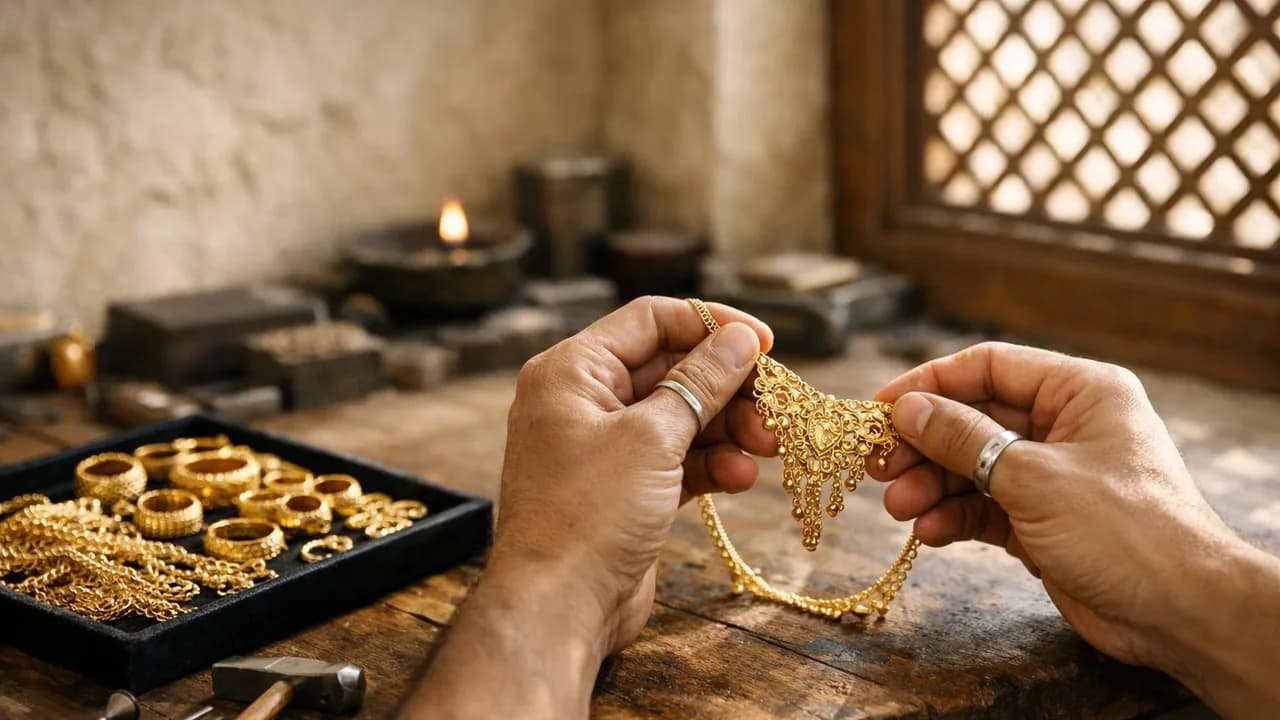
Buying gold on instalments is not halal when the gold is handed over now and the price is paid later, or when the price is paid now and the gold delivered later. Gold is one of the six ribawi commodities, and the classical rule, which AAOIFI codified in Shari'ah Standard No. 57 on gold, is that an exchange of gold for money must be completed hand to hand in the same session. Deferring either side turns a sale into a loan with a mark-up. The halal routes look different: save and buy outright, buy a small piece each month, or use a plan where you take possession of specific gold with each payment. Our is it halal hub covers the method; here it is applied to the Gold Souq, bank cards and buy now pay later in Qatar.
Ready to compare halal options?
Why gold is not like a sofa: the ribawi rule
Most things can be bought on deferred payment. A murabaha car, a sofa on a store instalment plan, a phone paid monthly: the Shariah has no objection to a sale where the goods arrive now and the price is paid later, provided the price is fixed at the outset. Gold and silver are the exception, together with a short list of staple foods, because the Prophet's hadith on the six commodities requires that when they are exchanged for one another the exchange be equal in kind and hand to hand, and when exchanged across kinds, such as gold for silver or gold for currency, hand to hand even if the amounts differ. Modern fiat money is treated by the overwhelming majority of contemporary scholars as taking the place of gold and silver in this rule, which is why a riyal-for-gold transaction has to settle on the spot.
The reason is riba al-nasi'ah, the riba of delay. If I hand you a gold coin today and you pay me QAR 20,000 in twelve monthly instalments, the delay is being priced into the sum, whether the shop admits it or not. If you pay me QAR 20,000 today and I promise a coin next year, you have lent me money against gold. Either way one side is a debt in a ribawi exchange, which is the thing the rule exists to prevent. AAOIFI's Standard No. 57, titled The Gold Standard on the organisation's own list, applies these classical rules to bullion, coins, jewellery and gold accounts; it is the reference your bank's Shariah board will cite if you ask.
What this does to the common Qatar arrangements
| Arrangement | What happens | Halal? |
|---|---|---|
| Pay cash or debit card at the Gold Souq, take the gold home | Both counter-values exchanged in the same session | Yes |
| Shop instalment plan: take the gold today, pay monthly | Gold delivered, price deferred | No: deferred price in a ribawi exchange |
| Layaway: pay monthly, collect the gold at the end | Price paid in parts, gold delivered later | No as a sale; acceptable only as a non-binding savings deposit with the shop |
| Credit card at the souq, pay the statement in full | Bank pays the shop at once; you owe the bank, not the jeweller | Accepted by most boards if the card is Shariah-compliant and settled without profit |
| Islamic bank card instalment plan on a gold purchase | Card balance converted to a profit-bearing instalment facility | Doubtful: the financing is on a gold purchase and the mark-up relates to it |
| BNPL split payment on gold | Provider pays the shop; you repay the provider in parts | Depends on the provider's contract; see below |
| Monthly plan where each payment buys and delivers a specific weight | A series of spot purchases | Yes, provided each tranche is possessed when paid for |
The table hides a distinction that matters: who is the counterparty to the gold exchange. When you buy with a card, the exchange of gold for money is between you and the shop, and it completes the moment the terminal approves the payment, because the shop is paid in full by the card scheme. Your later repayment to the bank is a separate obligation under the card contract, and the Shariah quality of that obligation depends on the card. Our guide to halal credit cards in Qatar covers how the Islamic banks structure theirs. What you must not do is convert that card balance into a profit-bearing instalment facility whose economic purpose is to finance the gold.
Credit card instalment plans: the published products
Two of the four Islamic banks publish card instalment products. QIIB's Installment Credit Card page describes a card that lets you repay outstanding balances in monthly instalments, with a minimum payment of 5% of the outstanding balance and a charge of 1% monthly on the outstanding balance, which the bank calls one of the most cost-effective cards in the market. QIB's cards section lists an Easy Payment Plan among the benefits of its credit cards. Both products are approved by their banks' Shariah boards as general-purpose facilities, usually on a tawarruq or covered-card basis, and neither page mentions gold.
Using one of them to spread the cost of a gold purchase is where the doubt lies. The bank's view is that it is financing your card balance, not your gold, and that the balance could have come from any merchant. The stricter view is that if you went to the souq intending to pay over twelve months at 1% a month, the substance is a deferred-price gold purchase with the bank as intermediary. We take the stricter view for bullion and coins bought as a store of value, and a more relaxed one for jewellery bought to wear, because jewellery has a large non-gold component of craftsmanship and the purchase is consumption rather than monetary exchange. Even then, the cleaner course is to pay the card statement in full.
BNPL and gold
Buy now pay later splits a purchase into instalments paid to a provider rather than the shop. Our examination of whether BNPL is halal in Qatar concludes that the contract turns on whether the provider charges the customer anything beyond the price and on how late fees are treated. For gold, an additional test applies. If the provider buys the gold from the shop and resells it to you on deferred terms, that is a deferred-price sale of a ribawi commodity and fails regardless of fees. If the provider pays the shop on your behalf and you repay the provider an identical sum in parts, the shop has been paid in full on the spot and the gold exchange is complete; what remains is an interest-free advance from the provider, which is permissible if it stays interest-free. Read the provider's terms to see which of the two it is; most Gulf BNPL contracts are written as the second but marketed like the first.
Layaway and savings plans at the souq
Doha's gold shops have long offered a monthly arrangement where you pay a sum each month and collect a piece when enough has accumulated. Whether it is halal depends on what the paper says. If it is a sale contract at a price fixed today for gold delivered in a year, it is a forward sale of a ribawi commodity and fails. If it is a savings deposit with the shop, with no sale until the day you choose a piece at that day's price, and your money is refundable, it is a permissible arrangement, though an unsecured one: you are an unsecured creditor of a jeweller for the balance. A third version, where each monthly payment buys a specific weight that is set aside in your name and can be collected, is a series of spot sales and is permissible if the gold really is allocated and available.
- Ask whether the monthly payment is a deposit or a purchase, and get the answer written on the receipt
- If it is a purchase, ask what weight was bought at what price per gram that day, and whether you can collect it immediately
- If it is a deposit, confirm it is refundable in cash on demand and that the gold price is set on the day of purchase, not on the day you began
- Check the shop's hallmarking and whether the piece is sold by weight at the day's rate plus a stated making charge
- Keep every receipt; a dispute over allocated gold is a dispute over whose property it is, and the receipts decide it
What the banks and the exchange do not offer
There is no published gold instalment product at any of Qatar's four Islamic banks. QIB's personal banking menu runs to accounts, cards, financing and takaful, with no gold line; the other three publish nothing on gold either. The Qatar Stock Exchange lists two ETFs, both equity funds, and no gold product. Our gold investing guide for Qatar reached the same conclusion: the souq and physical bullion are the realistic routes, with international gold-backed products as the alternative for larger sums. That absence is useful, because it removes the temptation: there is no bank-approved way to buy gold on credit in Qatar, so the question reduces to how you save for it.
A gold-backed fund or ETF raises a separate question that the AAOIFI gold standard addresses: whether a certificate representing allocated gold held by a custodian satisfies the requirement of possession. The majority view accepts allocated, specifically identified gold held to your order as constructive possession, and rejects unallocated accounts where you merely have a claim on the provider. If you use an international platform from Qatar, read the custody section before the fee section.
A halal plan for building a gold position monthly
The practical answer for most households is to reverse the order: save first, buy second, and buy small. A monthly transfer into a separate Islamic savings account, then a trip to the souq each quarter to buy a coin or a few grams at the day's rate, is a series of spot purchases and leaves you owning the gold, not owing for it. Our comparison of Islamic savings accounts gives the published rates for the holding account. Buying by weight at the daily rate plus a stated making charge, rather than by a bundled price, makes the gold component visible and makes the zakat calculation simpler later.
Two more points. Gold bought as a store of value is zakatable at 2.5% of its market value each lunar year above the nisab, and jewellery in regular use is treated differently by different schools; our complete zakat guide for Qatar sets out the positions. And gold bought at the souq is a long-term holding, not a trade: the buy and sell spread at a jeweller is wide enough that a position held under a year is unlikely to show a gain. Size it as insurance against currency and market shocks, not as an income asset.
Our verdict: which instalment arrangements to use and which to refuse
Refuse any plan that hands you gold today against a price paid over months, and any plan that takes your money today against gold delivered next year at a price fixed now. Both are deferred exchanges of a ribawi commodity and fail the rule that AAOIFI Standard No. 57 and every classical school apply. Treat an Islamic bank card instalment plan on bullion as doubtful at best and avoid it; pay a card purchase in full at the statement. Accept a souq savings deposit only if it is refundable and the purchase price is fixed on the day you buy, and accept a monthly plan only if each payment buys allocated gold you could carry out of the shop.
The cleanest answer is also the simplest: save in a halal account, buy outright, take possession, keep the receipt. It is slower than an instalment plan by exactly the length of the plan, and it is the only version that leaves you with gold and no debt. Facts checked against qiib.com.qa, qib.com.qa, aaoifi.com, qe.com.qa on 4 October 2026.
Frequently asked questions
Is it halal to buy gold jewellery on instalments at the Gold Souq?
Not as a deferred-price sale. Gold is a ribawi commodity, so taking the jewellery today and paying over months makes the delayed price a form of riba. Some scholars relax the rule for jewellery with a high craftsmanship value bought for wear, but the majority and AAOIFI's gold standard do not. Pay in full, or use a refundable savings deposit with the shop and buy when the balance is enough.
Can I pay for gold with an Islamic credit card?
Paying with a Shariah-compliant card and settling the statement in full is accepted by most boards, because the shop is paid in full at the terminal and your obligation to the bank is a separate card contract. Converting that balance into an instalment plan, such as QIIB's 1% monthly Installment Credit Card or QIB's Easy Payment Plan, is doubtful for bullion because the financing then serves a gold purchase.
Is buy now pay later on gold allowed?
It depends on the provider's contract. If the provider buys the gold and resells it to you on deferred terms, the sale fails as a deferred ribawi exchange. If the provider pays the shop on your behalf and you repay an identical sum with no charge, the gold exchange completed on the spot and the remaining obligation is an interest-free advance. Read the terms, and treat any customer fee beyond the price as disqualifying.
What about a gold savings plan where I pay monthly and collect later?
Permissible if it is a savings deposit with the shop, refundable on demand, with the gold priced on the day you buy. Permissible also if each monthly payment buys a specific allocated weight you could collect that day. Not permissible if it is a sale today at today's price for gold delivered in the future, because that is a forward sale of a ribawi commodity.
Do Qatar's Islamic banks sell gold on instalments?
No. None of QIB, Dukhan Bank, AlRayan Bank or QIIB publishes a gold product of any kind, and QIB's personal banking menu covers accounts, cards, financing and takaful only. The QSE's two ETFs are equity funds. Physical gold from the souq, bought outright, remains the main route, with allocated gold-backed products abroad as an alternative for larger sums.
Compare providers in your state
See side-by-side comparisons of Shariah-compliant products, or let our matcher recommend the best options for your situation.
Do I pay zakat on gold bought in instalments?
You pay zakat on gold you own at 2.5% of market value each lunar year once your zakatable wealth exceeds the nisab. If you still owe part of the price on a plan, the schools differ on whether the debt is deducted. Under a halal structure the question does not arise, because you only own gold you have fully paid for. Regular-wear jewellery is treated differently by different schools.