The best investment in Qatar for most residents in 2026 is the boring one: a published-rate Islamic term deposit, where QIIB pays up to 4.00% expected profit on a three-year riyal deposit and QIB's Growing Deposit pays up to 4.15% over ten years, both with Qatar Central Bank supervision and no currency risk. Beyond that, the halal menu is short and specific: the QATR ETF with charges capped at 0.50%, the Al Rayan GCC Fund from QAR 35,000, Shariah-screened QSE shares, sukuk through an international broker, gold from the souq at a 24-carat price the Zakat Affairs Department posted at QAR 483.5 per gram on 14 September 2026, and freehold-zone property. This page ranks all eight by minimum, published return, liquidity and expat access, so you can shortlist by horizon. Our halal investing hub explains the principles behind each.
Ready to compare halal options?
How we ranked the eight options
Every return quoted here comes from a bank rate page, the fund's own page or the ETF's key investor document fetched on the day of writing; where a provider publishes nothing, the row says quote-only. Risk is ranked on the plain question of whether you can lose capital, and liquidity on how quickly you can get riyals back without penalty. Expat eligibility is taken from each provider's published requirements. Zakat treatment is stated in one line per option because it changes the net return, and our complete guide to zakat in Qatar carries the detail.
| Rank | Option | Minimum | Published return | Liquidity | Expats |
|---|---|---|---|---|---|
| 1 | Islamic term deposits (QIIB, QIB, Dukhan, AlRayan) | QAR 10,000 at QIB and AlRayan; QAR 50,000 at Dukhan; not stated at QIIB | QIIB 2.25% to 4.00%; QIB 0.90% to 4.15% by product; Dukhan 1.45% to 1.55% | At maturity; early exit forfeits profit | Yes, with QID |
| 2 | High-profit savings accounts | Varies; QIB Misk QAR 10,000 for draws | Dukhan 0.60%; QIIB 0.50%; AlRayan Al Thahabi rate in PDF; QIB Misk by average balance | Instant | Yes |
| 3 | QATR ETF | One unit via QSE broker | Market return; charges capped at 0.50% | Intraday on QSE | Yes, with Edaa NIN |
| 4 | Al Rayan GCC Fund | QAR 35,000 | Target 12% a year, not guaranteed; 2.66% dividend June 2026 | Daily at NAV | Yes, any nationality |
| 5 | Direct QSE Shariah-screened shares | One share lot via broker | Market return and dividends | Intraday | Yes, with Edaa NIN |
| 6 | Sukuk | One SPSK share via IBKR; local access limited | SPSK 30-day SEC yield 5.04% at 30 Sep 2026, before 30% US withholding | Intraday (ETF) | Yes |
| 7 | Physical gold | One gram; QAR 483.5 for 24k on 7 Oct 2026 | Price change only; no yield | Same day at the souq, at a spread | Yes |
| 8 | Freehold-zone property | Hundreds of thousands of riyals plus fees | Rental yield quote-only; see our real estate guide | Months to sell | Freehold zones only |
Rank 1: Islamic term deposits with published rates
Three of the four Islamic banks publish expected profit rates on their sites, which is the reason deposits top this list: you can compare before you walk in. QIIB's term deposit page lists riyal rates of 2.25% for one month, 2.75% for three months, 3.00% for six months, 3.25% for one year, 3.50% for 18 months, 3.75% for two years and 4.00% for three years, with lower dollar rates alongside; the page requires a branch visit and an original QID but does not state a minimum. QIB's 2026 expected profit rates page gives ranges by product: Fixed Deposits 0.90% to 1.45% over one to five years, Flexi CD Premium 2.75% to 3.50% over one to three years, and Growing Deposits 3.50% to 4.15% over two to ten years, the last being a monthly savings plan from QAR 2,000 a month with 4.00% at five years and 4.15% at ten. QIB's fixed term deposit page sets a QAR 10,000 minimum.
Dukhan Bank publishes a month-by-month history: for September 2026 its mudarabah deposits paid 1.45% for one month, 1.50% for three months and three to six months, and 1.55% for six to twelve months in riyals, with a QAR 50,000 minimum on its fixed deposit page. AlRayan Bank's term deposit page sets a QAR 10,000 minimum for three to 24 month terms with quarterly profit, but its rate table sits in a PDF whose figures were not machine-readable when we fetched it, so treat AlRayan as quote-only until the branch confirms. The spread between QIIB's 4.00% and Dukhan's 1.55% at similar tenors is the single largest free lunch on this page. Early withdrawal forfeits profit at QIIB under its published deposit terms, so match the tenor to when you need the money. Zakat is 2.5% of the balance each lunar year. Our ladder-by-ladder comparison of Islamic term deposits in Qatar carries the full tables and the fine print.
Rank 2: high-profit savings accounts for money you may need
Savings accounts pay less than deposits and that is the price of instant access. Dukhan's published savings rate for September 2026 is 0.60% in riyals; QIIB's is 0.50%; AlRayan's Al Thahabi account page says it pays one of the highest expected rates in Qatar on balances up to QAR 2 million, accrues daily, pays monthly and allows one debit a month without losing the rate, but the rate itself is in the bank's PDF. QIB's Misk account pays profit on the average balance, credited quarterly, and enters you in prize draws once you keep QAR 10,000 a month, with the ninth edition announced in January 2026 offering a QAR 26 million pool. The honest ranking is: an emergency fund belongs here, long-term money does not. Zakat applies at 2.5% as with any cash.
Rank 3: QATR, the one halal ETF on the Qatar Stock Exchange
The Al Rayan Qatar ETF tracks the QE Al Rayan Islamic Index, holds only riyal securities, caps its annual charges at 0.50% of net assets, and charges no entry, exit or performance fee, according to its key investor information document on the QSE site, which records the fund's capital at QAR 463,276,221 on 31 December 2024. Dividends are paid at least once a year net of expenses and purification. You buy through any QSE member broker once you hold an Edaa investor number, and you can sell any trading day. It ranks third because it is cheap and liquid but it is a single-country equity fund, so expect the value to move with Qatari banks, industrials and telecoms. Zakat on an ETF held for the long term follows the underlying companies' zakatable assets; the Zakat Affairs Department publishes an annual bulletin of zakat ratios for QSE-listed companies, which makes the calculation possible. Our full QATR analysis covers the holdings and audited costs.
Rank 4: the Al Rayan GCC Fund for Gulf-wide active management
The GCC Fund page on alrayan.com publishes everything a buyer needs: QAR 35,000 minimum for individuals with QAR 5,000 top-ups, a subscription fee of up to 1%, a 1.25% annual management fee taken monthly, a performance fee of 20% on NAV gains above 24% over two years, daily dealing and NAV, dividends twice a year at the manager's discretion, and a target return of 12% a year that is explicitly not guaranteed. The latest declared dividend was QAR 0.069 per unit, a 2.66% yield on the 30 June 2026 NAV. It invests across GCC equities and sukuk with an 18 to 24 month view, is open to all nationalities, and is bought through AlRayan Bank branches. It ranks below QATR because the fee stack is far higher and the manager has to beat it; it ranks above direct shares because it does the Gulf-wide picking for you.
Rank 5: direct Shariah-screened shares on the QSE
Buying individual QSE shares is the highest-effort option. You need an Edaa NIN and a broker, you need to check each company against the QE Al Rayan Islamic Index constituents list or your own AAOIFI screen, you need to purify the non-compliant portion of dividends, and you carry single-company risk. The reward is zero fund fee and full control. The Zakat Affairs Department's bulletin on zakat ratios for the 2025 financial year, released on 10 June 2026, covered 45 listed companies and gives the per-share zakatable percentage for investors who hold for dividends; shares held for trading are zakatable at full market value. For most readers, QATR does this job at 0.50% a year; direct shares make sense for someone who wants to overweight a few names or hold a company the index excludes.
Rank 6: sukuk, mostly through an international broker
Retail access to sukuk in Qatar remains limited, which our sukuk guide for retail investors in Qatar explains in detail. The practical route for a resident is a US-listed sukuk ETF through Interactive Brokers or HSBC WorldTrader: SP Funds' SPSK charges 0.50%, tracks the Dow Jones Sukuk index, held mostly Saudi sovereign sukuk on 14 September 2026, and reported a 30-day SEC yield of 5.04% at 30 September 2026. The problem is tax: the IRS withholds 30% of US-source income paid to foreign persons, and Qatar has no treaty to reduce it, so a 5.04% yield becomes roughly 3.5% after withholding, below QIIB's published three-year deposit rate with more price risk. Sukuk rank sixth for that reason: the asset is sound, the retail route from Qatar is expensive.
Rank 7: physical gold
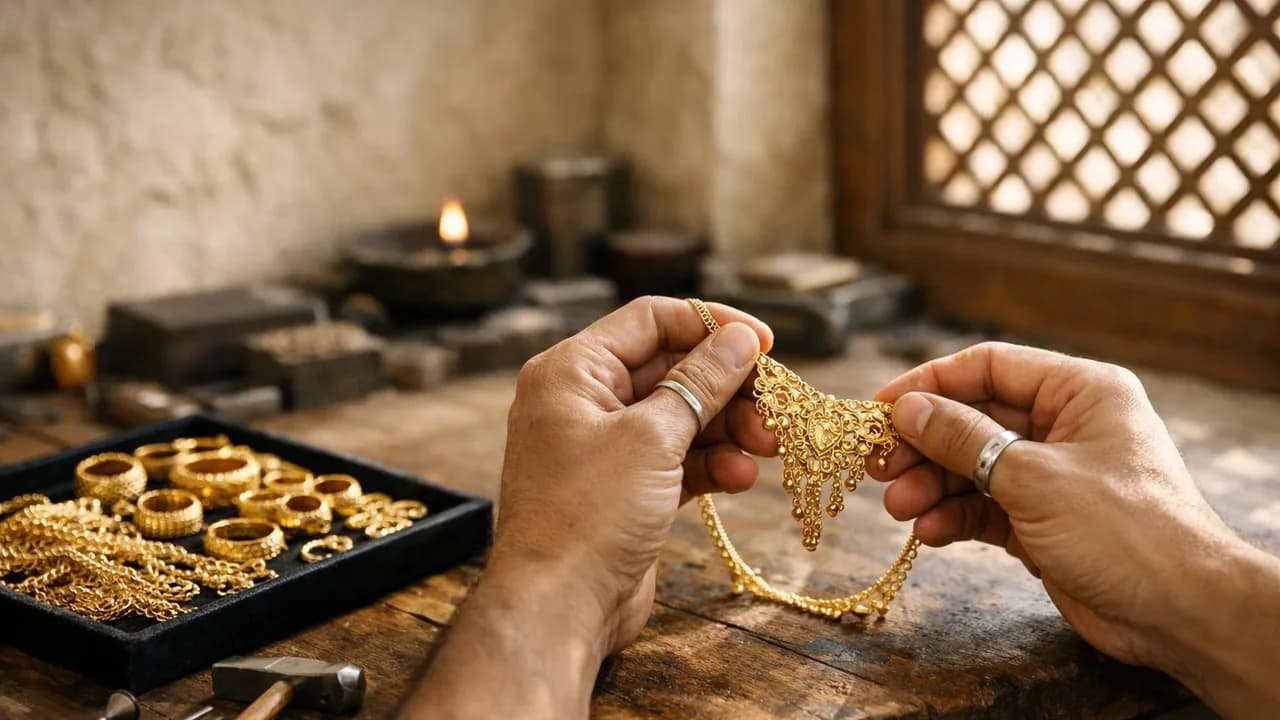
Gold is halal to hold, has no yield, and in Qatar is bought at the souq or from a bank rather than through a listed product. The Zakat Affairs Department's cash zakat calculator, which uses the gold price to set the nisab, showed a 24-carat gram price of QAR 483.5 and a cash nisab of QAR 41,097.5 on 14 September 2026, which is the cleanest official reference for what a gram costs today. Gold holdings above the nisab are zakatable at 2.5% of value each year, which is a real drag on an asset with no income. It ranks seventh because it protects against currency and inflation risk that a riyal saver does not face while the dollar peg holds, and because the buy-sell spread at the souq is a cost the gold price never shows. Pay for gold in full on the day; instalment plans fail the spot-exchange rule. Our guide to gold investing in Qatar covers where to buy and how to check purity.
Rank 8: freehold-zone property
Property is the largest ticket and the slowest exit on this list, and for expats it is confined to the designated freehold and leasehold zones. Rental yields are quote-only; no bank or developer page we fetched publishes a yield, and service charges, agency fees and void periods decide the net figure. Financing through the Islamic banks adds a profit cost that our honest guide to real estate investing in Qatar works through zone by zone. Property held to rent is, on the common scholarly view, not itself zakatable; the rental income that accumulates is. It ranks last not because it is a poor investment but because it should come after an emergency fund, a deposit ladder and a liquid equity holding, not before them.
What QAR 10,000, QAR 50,000 and QAR 200,000 can realistically do
- QAR 10,000 clears the QAR 10,000 minimum for a QIB or AlRayan term deposit, or buys QATR units through a broker; it does not reach the GCC Fund or Dukhan's deposit minimum, so pick one product and leave it alone
- QAR 50,000 can be split between a one-year QIIB deposit at a published 3.25% and QATR, or placed whole in the GCC Fund with QAR 15,000 left in a savings account; it also clears Dukhan's QAR 50,000 deposit floor
- QAR 200,000 supports a deposit ladder across tenors at QIIB (one, two and three years at 3.25%, 3.75% and 4.00%), a QATR core, a US halal equity ETF through an international broker, and a GCC Fund subscription, with zakat due on the lot each year
- At any size, keep three to six months of expenses in a savings account first; a term deposit broken early forfeits its profit, and an ETF sold in a bad month locks in the loss
- At any size, a US-listed fund paying income loses 30% of that income to US withholding, so keep income-producing holdings in riyals where you can
Expats should add one line to each plan: an end-of-service gratuity that arrives in a lump sum is the moment most people in Qatar first face this list, and the deposit ladder is the natural first home for it while the longer decisions are made. For how to buy the US-listed funds mentioned above, see our how-to for buying halal index funds and ETFs from Qatar.
What to avoid, and why
Three things fail the halal test or the common-sense test. Conventional deposits at QNB, Commercial Bank or Doha Bank pay interest, which is riba whatever the headline rate, and Qatar's ban on Islamic windows means those banks have no compliant alternative product; the Islamic banks' published rates above are the replacement. Unlicensed platforms, including offshore brokers and crypto exchanges marketing to Qatar residents on social media, carry no QFMA or QCB protection; check the regulator's register before sending money, and remember that Qatar's position on crypto is covered separately on this site. Gold bought on instalment, whether a souq plan, a buy-now-pay-later app or a deferred card payment for bullion, breaks the rule that gold must be exchanged hand to hand; save first, then buy.
Verdict by horizon
Under two years: term deposits only, laddered at QIIB where the published rates are highest, with the emergency portion in a high-profit savings account. Nothing on this list that can lose capital belongs in money you will need in 24 months. Two to five years: a QIIB or QIB deposit for the larger part and QATR for the smaller, with the GCC Fund as the active alternative if you have QAR 35,000 to commit and accept its fee stack. Five years and beyond: QATR and a US halal equity ETF as the core, the GCC Fund if you want Gulf-wide active management, gold as a small hedge bought outright, and property only after the liquid portfolio is in place and only in a freehold zone if you are an expat.
If you are unsure which of the four Islamic banks fits your salary and residency, our bank accounts hub compares them, and our matching tool narrows the field by what you are trying to do. Whatever you choose, the published rates on this page change; QIB's page says its expected rates move with market conditions, and Dukhan revises monthly, so check the bank page the day you sign. Facts checked against qiib.com.qa, qib.com.qa, dukhanbank.com, alrayan.com, qe.com.qa, sp-funds.com, irs.gov, zf.org.qa on 14 September 2026.
Frequently asked questions
What is the best investment in Qatar for expats?
For most expats, a laddered Islamic term deposit at QIIB, which publishes riyal rates from 2.25% for one month to 4.00% for three years, followed by QATR for equity exposure. Both need only a QID and, for QATR, an Edaa investor number. Property is restricted to freehold zones for expats, and US-listed funds lose 30% of dividends to US withholding, so keep income in riyals.
Which bank gives the highest profit rate on deposits in Qatar?
On the pages fetched for this article, QIIB publishes the highest standard term deposit rate, 4.00% expected profit on a three-year riyal deposit, and QIB's Growing Deposit publishes 4.15% at ten years as a monthly savings plan. Dukhan's published mudarabah rates run 1.45% to 1.55%, and AlRayan's rates are in a PDF we could not read, so ask its branch.
Is investing in the Qatar Stock Exchange halal?
It can be. The QE Al Rayan Islamic Index lists the QSE companies that pass AlRayan Bank's Shariah board screen, and the QATR ETF holds exactly those. Buying other listed companies requires your own screen of their activities and debt, and dividends from companies with some non-compliant income must be purified. The Zakat Affairs Department's annual bulletin of zakat ratios covers 45 listed companies.
Can I invest QAR 10,000 in Qatar?
Yes. QIB and AlRayan both set QAR 10,000 as the minimum for a term deposit, and QATR units can be bought through a QSE broker for far less. The GCC Fund needs QAR 35,000 and Dukhan's fixed deposit needs QAR 50,000, so those wait. Keep an emergency fund in a savings account before locking the QAR 10,000 away.
Is gold a good investment in Qatar?
Gold is a hedge rather than a return engine: it pays nothing, carries 2.5% zakat each year above the nisab, and is bought at a souq spread. The Zakat Affairs Department posted a 24-carat price of QAR 483.5 per gram on 14 September 2026. It earns a small place in a long-term portfolio, bought outright and in full, not a large one and not on instalment.
Compare providers in your state
See side-by-side comparisons of Shariah-compliant products, or let our matcher recommend the best options for your situation.
Do I pay zakat on my investments in Qatar?
Yes, if your zakatable wealth exceeds the nisab, which the Zakat Affairs Department set at QAR 41,097.5 on 14 September 2026. Deposits, savings and gold are zakatable at 2.5% of value; shares held for trading at market value; shares and funds held for the long term on the companies' zakatable assets, for which the Department publishes annual ratios; and rented property on the accumulated rent rather than the building.